Show what supports it.
A data field, policy source or direct quote supports the claim. A quote can verify what someone said; it cannot prove the underlying event happened.
An AI-to-human support handoff console. When an AI agent hits its limit mid-chat, Handoff gives the human agent a three-line brief, confidence-tagged claims (verified, inferred, uncertain), and sourced reply suggestions, then captures their corrections to improve the next draft. Designed in Claude Design and built with Claude Code, using real LLM calls and a repeat-run evaluation set.
briefs evaluated across eight transcripts, five runs each
required checks passed: 170 of 185
predefined claims that must not be verified stayed unverified
Prototype results on test data, including five AI-authored sample cases. The predefined checks did not catch every trust issue.
Explore evaluation and limitations ↗When an AI support agent reaches its limit, a human inherits a conversation they never saw. A transcript alone leaves them to reconstruct what happened, what the AI tried, and which claims they can trust—all while the customer waits.
I set a narrow goal: help the human agent understand the situation and decide what to say next from one screen. I designed the console in Claude Design, built it with Claude Code, and tested its model-generated briefs rather than stopping at a polished interface.
Solo designer & AI-assisted builder
Product design, implementation, prompts and evaluation
Claude Design · Claude Code · Claude API
Next.js, TypeScript, Tailwind and Zod
Almost eight hours
Working prototype on sample data
The brief should orient the agent quickly. Confidence labels and expandable evidence let them inspect a claim before acting. The evaluation later showed that the brevity goal still needed work.
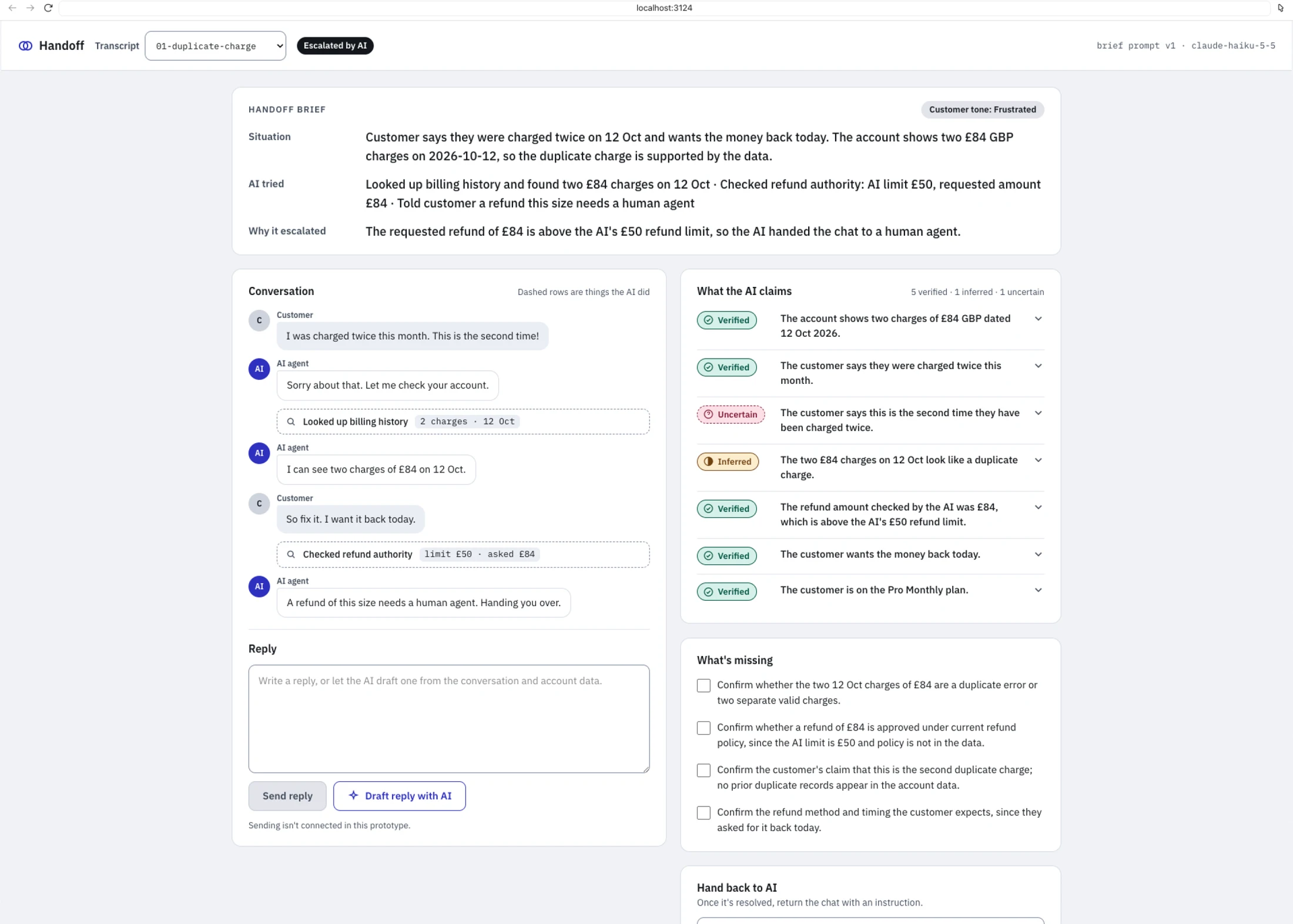
The brief answers three questions: what is happening, what the AI already tried, and why it escalated. The conversation and reply sit on the left; claims, missing information and the hand-back instruction sit on the right.
A data field, policy source or direct quote supports the claim. A quote can verify what someone said; it cannot prove the underlying event happened.
A reasonable reading of the evidence that the evidence does not state directly.
The claim lacks confirmation. Icons, labels and border styles distinguish the states without relying on colour alone.
A duplicate-charge escalation shows the core flow. The human can inspect evidence, request a sourced draft, edit it, and explain what needed correcting.
The console separates account-backed facts, interpretations, and unconfirmed customer assertions.
The working prototype uses real model calls. The recording follows the brief, expandable evidence, draft generation and correction flow.
Two short customer messages and no account match are not enough for a confident explanation. The low-context banner makes that limitation explicit, and the checklist helps the agent ask useful questions first.
The brief stays short on purpose when the customer and problem cannot yet be identified.
The low-context case makes the missing information visible rather than inventing a complete account of the issue.
The AI quoted policy v3.1 and a ten-working-day refund timeline. The current sample policy, v3.2, says five. A warning above the reply composer directs the human to check the source before continuing.
The source warning is deterministic string matching against the policy file, separate from model confidence labels.
The console flags a superseded policy cited earlier in the conversation. The build warns; it does not automatically remove the sentence from a draft.
When the human edits a draft, they can tag the issue: wrong policy, tone, outdated information or missing context. The last five saved corrections enter the next reply prompt, and the console reports how many it used. This is prompt context, rather than model retraining.
Send remains disabled because this prototype cannot send a message. Hand-back records an instruction; there is no live AI agent to receive it.
I used Claude Code to build from the Claude Design canvas, then directed the API behaviour, validation, error states and evaluation. The build log records what the agent got wrong and the decisions I made in response.
Write the brief prompt and API route before the console UI. Keep a baseline before changing the prompt.
Validate output after every model call with Zod. Disable default silent retries and distinguish invalid output, timeouts, refusals and API errors.
Send only transcript IDs and messages to the brief model. Keep expected answers out of the prompt to avoid answer leakage.
Build sourced drafts, correction capture and repeatable runs. Inspect the console at desktop and mobile sizes.
The SDK moved some enum values and list limits into descriptions. I kept post-call Zod validation as the real gate, including the rule that a claim without evidence cannot be verified.
The preview tool reported a running server while nothing was listening. Browser checks exposed that issue and a Next.js file-read error. Both had to be fixed before the console could be reviewed.
I wrote three transcripts by hand: a clear duplicate charge, a claim contradicted by account data, and a chat with almost no context. Claude Code generated five additional, labelled sample cases. Each of the eight ran five times, producing 40 briefs with the frozen v1 prompt.
Code checked sentiment, word counts and evidence presence. A stronger model graded meaning-based checks and had to quote the brief text supporting its verdict. Required checks focused on trust; stretch checks focused on coverage.
92% passed across verified claims, claims that must not be verified, sentiment, escalation reasons and limited-context handling.
89% passed on situation coverage and missing-information prompts. These are repeated checks on test cases, not a production success rate.
Only nine situation lines met the one-sentence rule without semicolons. Lines ran 24–43 words; missing-information lists ran 3–7 items.
My spot-check agreed with all six judge passes and one of four fails. The three disagreements were partial matches I would accept. Ten items show a direction, not a reliable agreement rate.
After one run, v2 appeared to fix sentiment. Repeated runs showed v1 already returned “calm” consistently in that case. V2 improved one escalation field but weakened other important information.
I kept v1 as the default and drafted v3 without claiming it had been tested.
All 45 predefined “must not be verified” checks passed. To look beyond that list, I audited the evidence categories across 221 verified claims: 140 cited data fields, 74 relied only on customer quotes, and seven relied only on AI-agent quotes.
The audit surfaced an assertion that the customer had cleared their cache, supported only by “Of course I did.” Another brief invented the customer’s gender. Neither issue was covered by the predefined checks. The quote-only wording check used a heuristic and a read of flagged rows, not a manual review of every claim.
The most useful learning came from checking where confidence labels, prompt revisions and evaluation scores could mislead the human using them.
A single model response is a hint. Repeated runs exposed both improvements and regressions before I changed the default.
Add checks for assertions presented as facts and invented details. The original trap list missed both.
Test v3, improve escalation reasons, and prioritise missing information that blocks the human’s next action. Recheck the grader against human judgments.
I’m always open to interesting conversations—about design or what comes next.